Plate VII · Terroir
Organic and natural wines of Alsace: the Stierkopf and the Bruche valley
The flesh of the fruit, the spirit of the land. Our vines grow on a single terroir: the sandstone outcrop of the Stierkopf, in Mutzig, a place first recorded in the year 916. The grapes are made into wine a few kilometres away, in Lutzelhouse, in the Bruche valley, between Alsace and the Vosges.
An Alsatian terroir with two faces
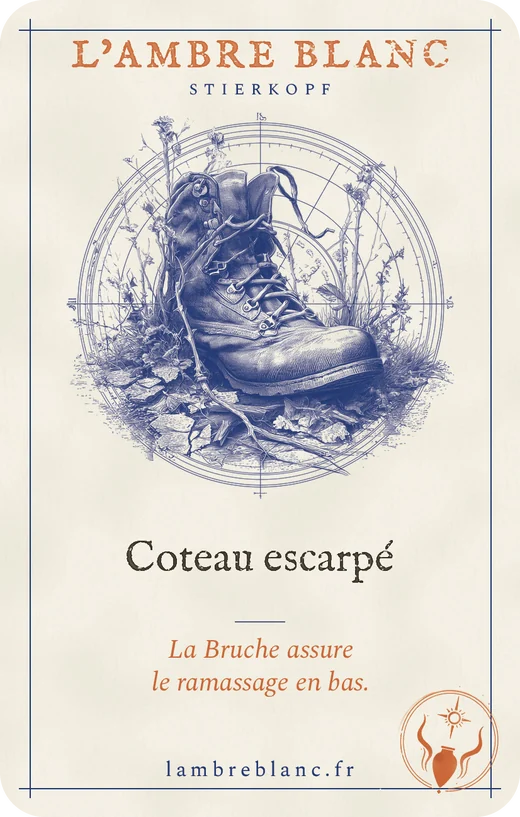
All our vines are in Mutzig: since February 2026, 4 hectares on the Stierkopf hillside, a historic terroir facing due south, between 150 and 300 metres of altitude, on marl-limestone soils with sandstone outcrops, a fault zone at the transition between the Vosges mountains and the Rhine plain. The cellar is in Lutzelhouse, in the Bruche valley, at the foot of the Vosges, away from the main axis of the Alsace vineyard: a barn built in 1817 and, behind it, the marani where our qvevris are buried.
A thousand-year-old site, a new chapter
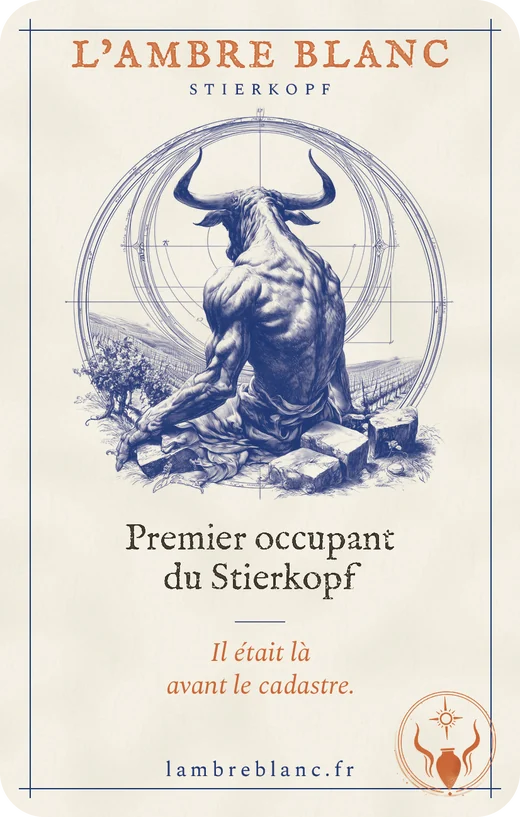
"Stierkopf" ("Bull's Head") is first mentioned in writing in the early 10th century, as the property of the Bishop of Strasbourg — one of the oldest wine-growing sites in Alsace. The prince-bishops of Rohan helped it flourish in the 17th and 18th centuries, and the winegrowers' guild of Mutzig became one of the most powerful in the region. In 2011, the estate then farming the Stierkopf took over these plots and converted them to organic farming. In 2026, three leases brought 4 hectares to l'ambre blanc: living wines, with no additives, born of this thousand-year-old terroir — the first chapter of a new story.
Pruning that listens to the vine
On the Stierkopf, we practise physiological pruning, by hand secateurs only. Every cut respects the flow of sap: we never cut where the sap is running, leaving it its natural paths — a slow, attentive kind of pruning that means reading the wood before cutting it.
The Pinot Noirs, from Burgundian massal selections, are trained in Royat cordon, a low form that favours vegetative balance. The other varieties are trained in Guyot, without ever forcing the shape: a vine is a liana, it climbs, stretches, seeks the light its own way. The Rieslings have been there since 1953 — seventy-three years of memory in this soil, vines that have lived through changing fashions and market whims, and that tell their terroir's story better than any recent clone could.
A living hillside
Between the rows, life has taken back its place. Vine peaches, apricot, almond, walnut, fig and olive trees have been planted throughout the Stierkopf hillside, alongside clumps of rosemary, thyme, lavender and sage — not as decoration, but as neighbours. They attract beneficial insects, shelter wildlife, enrich the hillside's scents, and may, one day, find their way into the memory of a wine.
Birdhouses line the rows: great tits, robins and nuthatches do the work that pesticides long claimed to do better — we trust them instead. Lizards and ladybirds have settled on the hillside; snowdrops and wildflowers form a natural ground cover rather than bare, weeded soil.
Fruit trees
Vine peaches, apricot, almond and olive trees.
Aromatic herbs
Rosemary, thyme, lavender, sage.
Other plantings
Walnut and fig trees.
Birdhouses
Great tits, robins, nuthatches.
Hillside wildlife
Lizards and ladybirds spotted on site.
Natural ground cover
Snowdrops, wildflowers.
The grape varieties of our Alsace wines
Sylvaner, Pinot Noir, Riesling, Pinot Blanc, Gewurztraminer and Pinot Gris — the historic grape varieties of Alsace, organically farmed (FR-BIO-01), hand-harvested and made with no additives. The Georgian qvevri remains at the heart of our work, but the cellar also holds 3 foudres, 11 barrels and 5 stainless steel tanks — each cuvée finds the vessel that suits it. Our wines are currently made as Vin de France (VDF), except Dorò, which is AOC Alsace.
Natural wine from Alsace: what it means here
Natural wine has no legal definition. At l'ambre blanc it is a precise commitment, for every cuvée: certified organic grapes, 100% hand harvesting, spontaneous fermentation with only the yeasts of the grape and the cellar, no additives, no fining, no filtration. The wine is bottled as it is, sometimes cloudy, always alive. Our commitments in detail.
Certified organic Alsace wine
All our wines are certified organic (FR-BIO-01): the grapes come from certified organic partner growers and, since 2026, from our own vines on the Stierkopf. Organic sets the rules in the vineyard; natural wine goes further in the cellar: no additives, no fining, no filtration.
Visit us
49 Rue Principale, 67130 Lutzelhouse, Bruche valley, Alsace, France — 35 minutes from Strasbourg. Visits and tastings by appointment.
Frequently asked questions
- Where is the l'ambre blanc vineyard located?
- The cellar is in Lutzelhouse, in the Bruche valley (Bas-Rhin, France). Our own vines are on the Stierkopf hillside, in Mutzig, a few kilometres away.
- Which grape varieties go into l'ambre blanc's Alsace wines?
- Sylvaner, Pinot Noir, Riesling, Pinot Blanc, Gewurztraminer and Pinot Gris, all organically certified.
- Can I visit l'ambre blanc?
- Yes, by appointment, in Lutzelhouse — contact us to arrange a visit of the cellar and the marani, the garden where the qvevris are buried.
- Are your Alsace wines organic?
- Yes, all of them are certified organic (FR-BIO-01), whether the grapes come from our Stierkopf vines or from certified organic partner growers.
- Where can I buy natural wine from Alsace?
- In our online shop (free delivery in France from €150), or at the cellar in Lutzelhouse, by appointment, 35 minutes from Strasbourg.