Plate IV · Winemaking
Qvevri, or kvevri: fermenting in the earth
A buried Georgian amphora, a wine that ferments at the pace of the soil — the world's oldest winemaking technique, alive today in a 1817 stone barn in Alsace, France.
Qvevri or kvevri: one amphora, two spellings
Qvevri and kvevri (ქვევრი) are the same word: a Georgian clay vessel used for over 8,000 years to ferment and age wine. Both English transliterations are common — "qvevri" is more widespread in English and German-speaking countries, "kvevri" is the spelling most often used in France. The qvevri winemaking method has been inscribed on UNESCO's Representative List of the Intangible Cultural Heritage of Humanity since 2013.
At l'ambre blanc, we use both spellings — whichever brought you here, you're in the right place: it's the same amphora, the same gesture, the same living wine.
Qvevri winemaking at l'ambre blanc
In the orchard-garden behind our 1817 stone barn in Lutzelhouse, our Georgian qvevris are buried directly in the Alsatian earth. These fired-clay vessels have their pores sealed with beeswax through heating, which makes the clay watertight from the inside. Buried, shielded from light and sheltered from sharp swings in temperature, they allow for a slow fermentation with no mechanical intervention — the grapes ferment in contact with their own skins and seeds, infused with silence and season. No additives, no fining, no filtration: the qvevri lets the wine become what it is meant to be.
The marani
Our qvevris are buried in the orchard and kitchen garden next to the barn: this is our marani, the Georgian name for the place where the jars sleep. Here it is open to the sky. The first qvevri went into the ground in August 2022, in a pit dug by hand by Yann Molla Weber; there are now sixteen of them, holding about 80 hectolitres.
All our qvevris come from Georgia. The potters who still know how to make them number about ten, all of them Georgian.
How a qvevri is made
A qvevri, or kvevri, is built by hand, coil by coil: the potter lets each ring of clay dry before adding the next, so that the jar can bear its own weight. Once dry, it is fired in a kiln, then coated inside with beeswax while still hot, so the wax soaks into the pores of the clay. On the outside, a layer of lime protects it before it is lowered into the pit.
Its egg shape, with no handles and no foot, is no accident: during fermentation the skins and seeds circulate in the jar, then settle at the bottom, in the point, so that the wine clears by itself.
A family story
This choice isn't just a winemaking method — it's also a matter of roots. Yann Molla Weber's Greek heritage connects him to these amphora-winemaking gestures, familiar and almost archaic, passed down before they were ever learned. At l'ambre blanc, making wine in qvevri means reconnecting with an ancient, humble, earth-bound gesture, rather than following a trend.
From vine to amphora: the steps
-
Hand harvest
Picked by hand, in small crates, to preserve the integrity of each berry.
-
Filling the qvevri
The grapes (sometimes whole clusters) go straight into the buried amphora, with no prior pressing for long macerations.
-
Spontaneous maceration & fermentation
From a few days to ten months depending on the cuvée, no added yeast, no temperature control — the qvevri regulates naturally.
-
Direct pressing or racking
A gentle separation of wine and skins, with no additives or filtration.
-
Bottling
Unfiltered, unfined wine, with no added sulphites or a pinch if needed, at the right moment (contains naturally occurring sulphites).
Why bury the amphora?
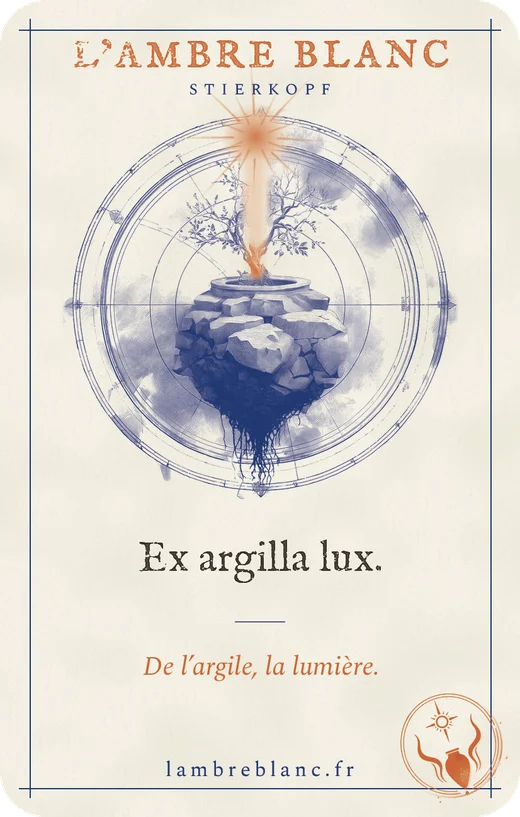
Buried, the qvevri is shielded from day-to-night temperature swings: fermentation happens in a stable climate, with no air conditioning or cellar heating. The beeswax lining makes the wall almost airtight: exchanges with the air stay very slight, and the amphora gives no oaky flavour. The style of the wine comes first from the grapes and the length of maceration: here, wines with texture and a fine tannic grip, even in the whites.
Qvevri, amphora, jar: what sets them apart
Qvevri wine is often called “amphora wine”, and the word helps picture the vessel. But the ancient amphora, Greek or Roman, was made for transport: two handles, a narrow neck, a pointed base to wedge it into a ship's hold. The qvevri does not travel: it is made to stay underground, often for generations. The Spanish tinaja, standing above ground, has neither its shape nor its burial. And the qvevri is not just a container: it is a whole method, from fermentation on the skins to ageing.
Amber wine, born in the qvevri
In Georgia, white grapes fermented and macerated with their skins in a qvevri give a wine the colour of amber: Georgians call it “amber wine”, elsewhere it is known as “orange wine”. The colour comes from the skins of the white grapes and the time they spend macerating. The qvevri takes red wines too: at l'ambre blanc, skin-macerated whites and pinot noir both go through it.
Our qvevri-aged cuvées
Most l'ambre blanc cuvées spend all or part of their ageing in qvevri — from a short maceration of a few days to a long ten-month maceration. Find the details of each method on our natural wines from Alsace pages.
Frequently asked questions
- Qvevri or kvevri, what's the difference?
- None: these are two Latin transliterations of the same Georgian word (ქვევრი), referring to the same fired-clay amphora.
- Does the qvevri give the wine a particular flavour?
- Not in the way wood does: fired, waxed clay adds no oak and no vanilla. What you taste is the grapes, the maceration and the time spent ageing.
- Why are qvevris buried?
- The earth cushions temperature changes: fermentation proceeds calmly, with no air-conditioning or heating, and the amphora is protected.
- Is qvevri wine a natural wine?
- The qvevri technique is traditionally associated with natural and orange wines, since it suits a winemaking approach with no additives, no added sulphites and no filtration — the approach l'ambre blanc takes.
- What is the difference between a qvevri and an amphora?
- The ancient amphora was used to transport wine: handles, a narrow neck, a pointed base. The qvevri has no handles and is buried, to ferment and age the wine where it stands.
- Where can I buy qvevri wine from Alsace?
- Our qvevri-made cuvées from Alsace are sold in our online shop, with free delivery in France from €150, or at the cellar in Lutzelhouse, by appointment.